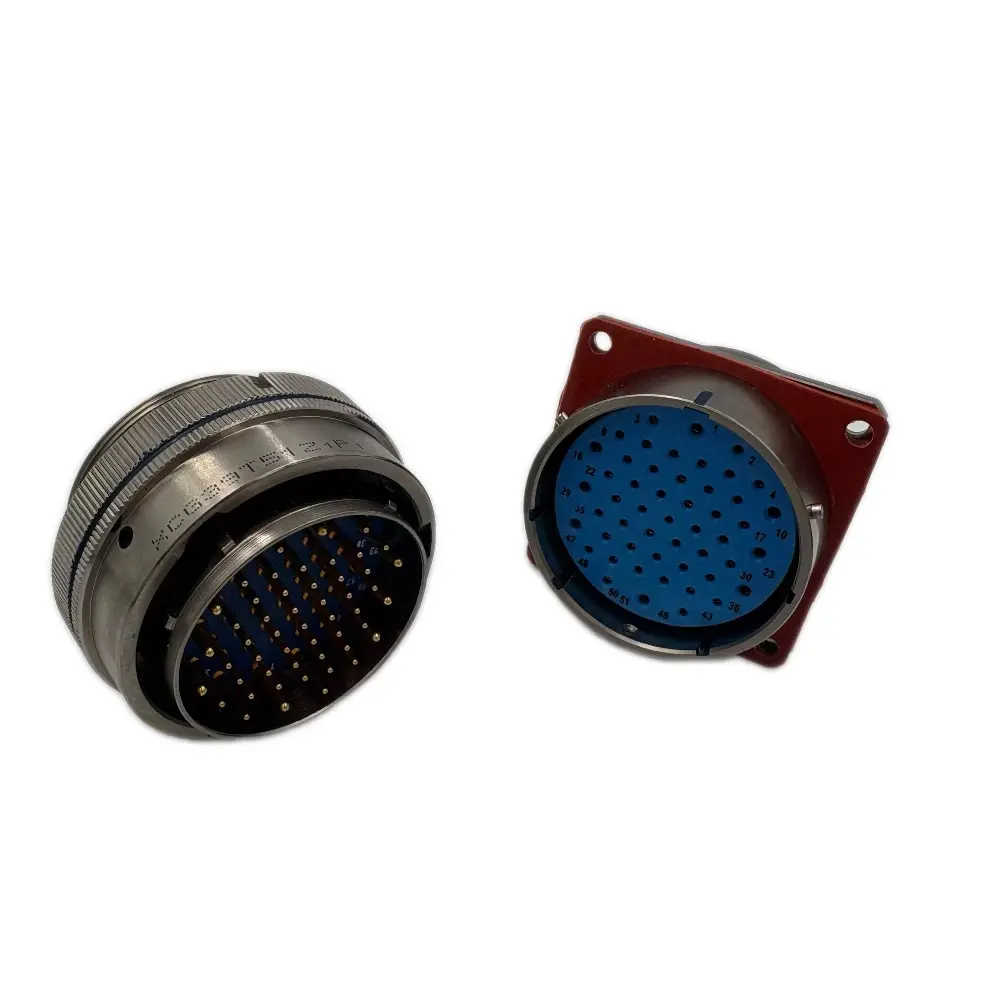
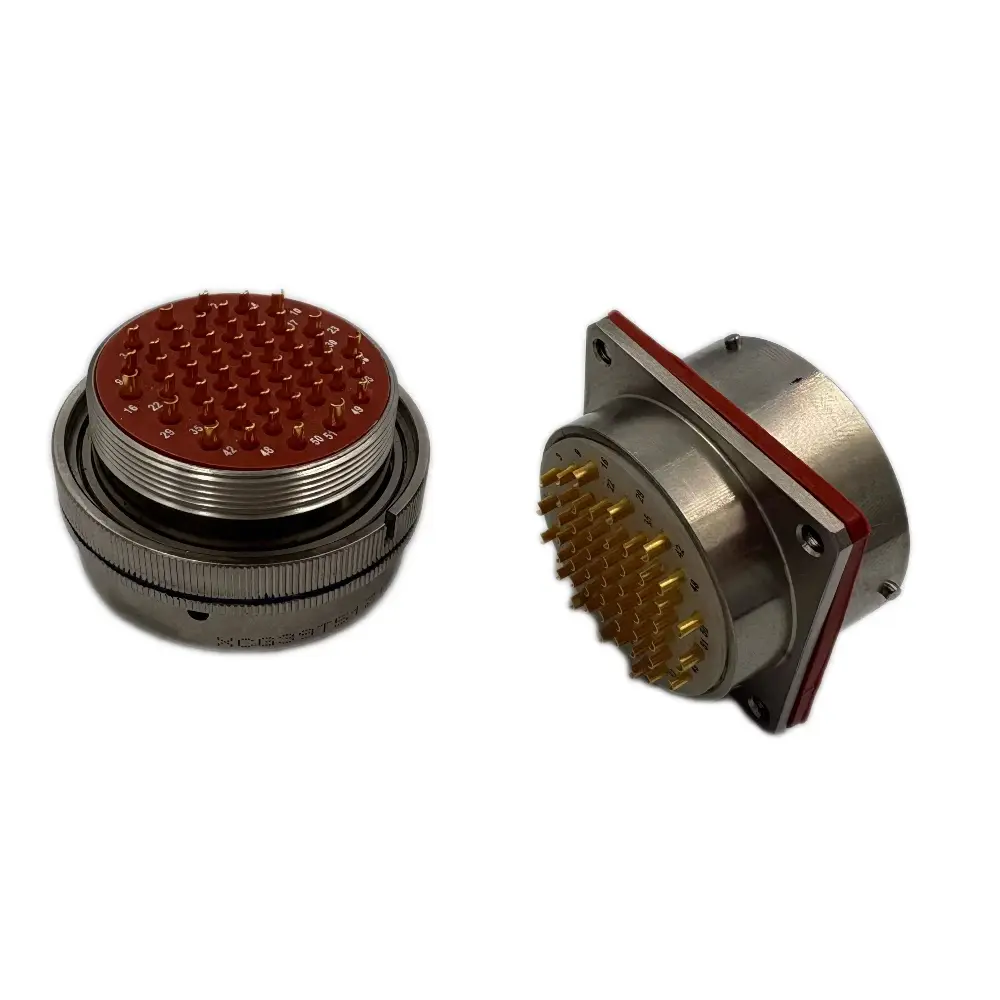
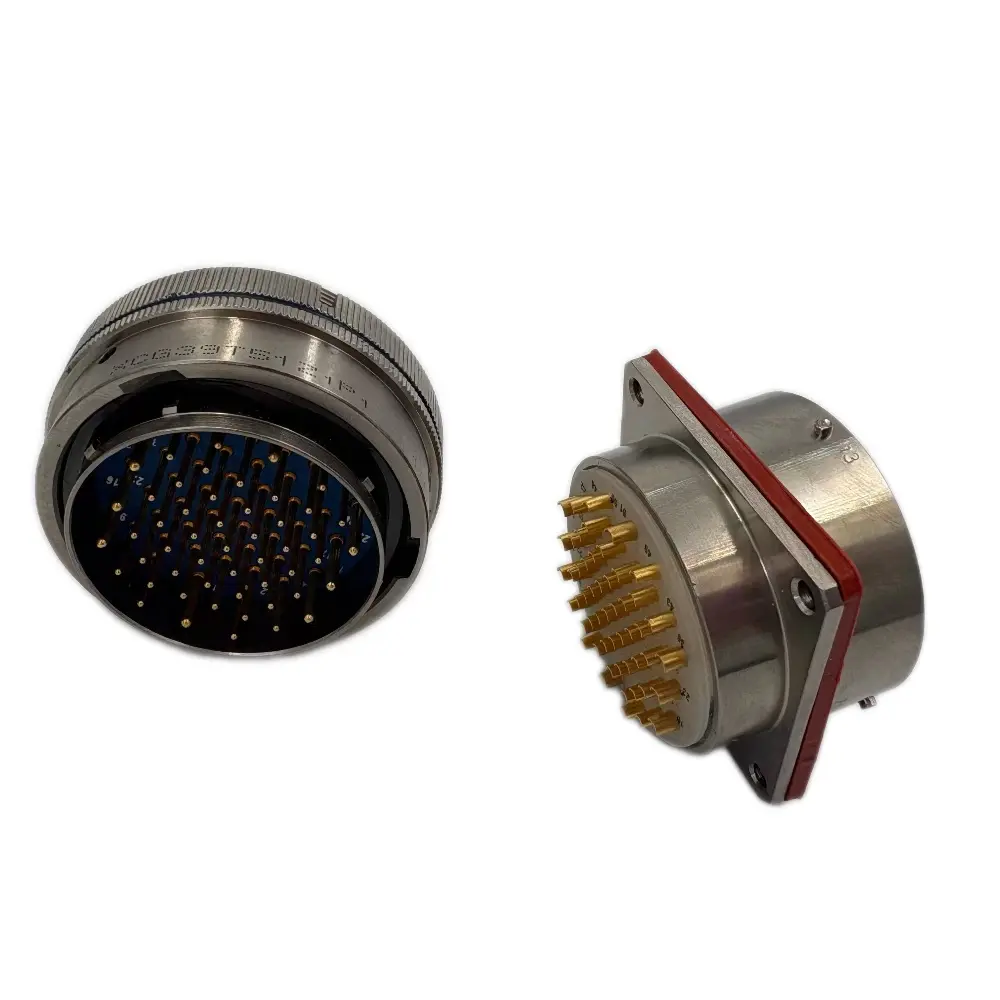
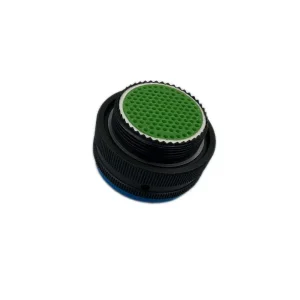
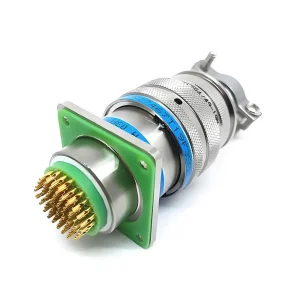
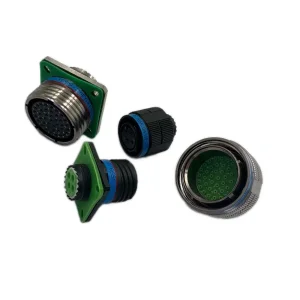
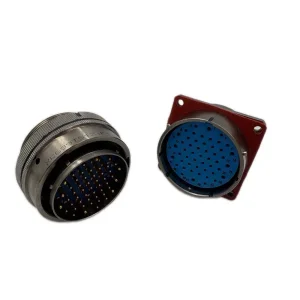
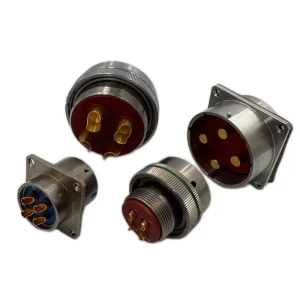
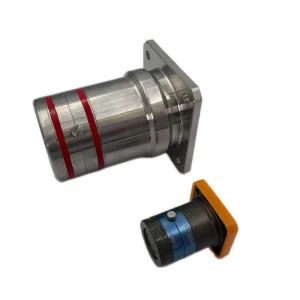
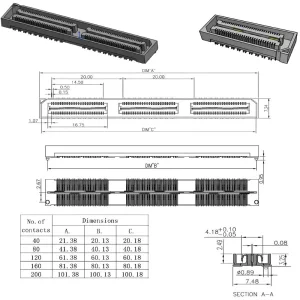
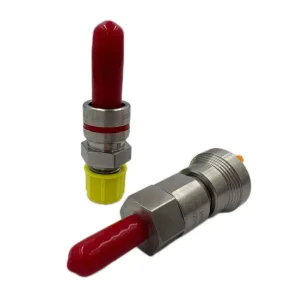
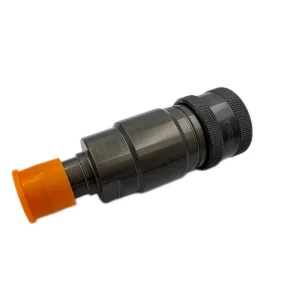
Bayonet quick connection Adopting hyperbolic wire spring socket Multiple end connection methods including crimping welding, and printed board welding Multiple types of plug and socket structures and coatings Five key positioning with blind insertion and error prevention functions Widely used in aviation and aerospace; ships and other military fields Main technical performance
Glass Sintering Airtightness: Pressure difference of 152KPa, leakage rate of 0.1 Pa·cm³/s
Electrical connectors also have good properties such as moisture resistance, mold resistance, rain resistance, and sand and dust resistance.
Electrical Performance
Contact Resistance and Rated Current (by Dimension)
Dimension (mm)
Universal Contact Resistance (mΩ)
Through-wall Seal Contact Resistance (mΩ)
Square Disk Sealing Contact Resistance (mΩ)
Rated Current (A)
Φ1.0
≤5
≤10
≤15
5
Φ1.5
≤2.5
≤5
≤7.5
10
Φ2.0
≤1.25
≤2.5
≤3.75
20
Φ2.5
≤0.75
≤1.5
≤2.25
40
Contact Resistance and Rated Current (by Environment)
Operating Environment
Sealed Electrical Connector
Ordinary Electrical Connector
Rated Voltage (V)
Withstand Voltage (V)
Rated Voltage (V)
Withstand Voltage (V)
Room Temperature
500
1500
500
1500
Moist and Hot State
500
750
500
1125
Low Pressure Conditions (1kPa)
150
300
250
300
Insulation Resistance MΩ
Work Level
Standard Condition
High Temperature
Moist and Hot
Insulation Resistance
≥5000
≥1000
≥100
Electrical Continuity Between Enclosures
Aluminum Alloy Shell: 5.0 mΩ
Steel Shell: 15.0 mΩ
Frequently Asked Questions
What is the difference between the wall sealing adapter and the glass sintering socket in terms of airtightness?
The wall sealing adapter has an airtightness leakage rate of 4.6 Pa·cm³/s under a pressure difference of 50.7kPa, whereas the glass sintered square disc sealed socket features a much higher airtightness with a leakage rate of only 0.1 Pa·cm³/s under a 152KPa pressure difference.
What materials are used for the contacts and insulators in these connectors?
For ordinary and through-wall sealing adapters, contacts are made of copper alloy (silver or gold plated) and insulators are thermoset materials. For glass sintered sockets, contacts are made of ferroalloy (nickel or gold plated) and insulators are glass body.
What is the mechanical life and environmental durability of these connectors?
These connectors feature a mechanical life of 1000 cycles. They can withstand vibrations up to 2000 Hz, constant acceleration up to 980m/s², and have salt spray resistance ranging from 96 hours (nickel/galvanized) up to 1000 hours (stainless steel passivated).
How does operating environment affect the withstand voltage?
At room temperature, both sealed and ordinary connectors withstand up to 1500V. Under moist and hot states, sealed connectors withstand 750V and ordinary ones withstand 1125V. Under low pressure (1kPa), both types withstand up to 300V.
What is the maximum operating temperature range for these electrical connectors?
The electrical connectors are designed for extreme environments, with an operational temperature range spanning from -55℃ to +200℃.
What is the electrical continuity performance between the connector shells?
The electrical continuity between enclosures depends on the material: it is 5.0 mΩ for aluminum alloy shells and 15 mΩ for steel shells.
 Dynalink Electronic